
Shockwave Therapy for Shoulder Pain in Greater Victoria
It starts as a dull ache in the shoulder. Then one morning you reach for something off a shelf and a sharp, searing pain stops you cold. If your doctor has mentioned calcium deposits in your shoulder tendon, you likely have calcific tendinitis. If you’re wondering whether there’s something that can actually break up those deposits and get you back to full function, you’re right to ask about shockwave therapy.
Here’s what calcific tendinitis is, why it hurts so much, and what the evidence says about shockwave therapy as a treatment.
Key Takeaways
- Calcium Deposits – Calcific tendinitis happens when calcium builds up in the rotator cuff, most often in the supraspinatus tendon.
- Resorptive Phase Pain – The most intense pain usually strikes when your body starts reabsorbing the calcium, not when it first forms.
- Shockwave Therapy – Extracorporeal Shockwave Therapy (ESWT) uses acoustic pressure waves to help break up deposits and kickstart healing.
- Strong Evidence – Recent research shows ultrasound-guided shockwave therapy delivers significantly better results than non-guided approaches.
- Local Care – South Island Physiotherapy in Saanich offers diagnostic ultrasound and shockwave therapy for patients across Greater Victoria, including Oak Bay, Langford, and Esquimalt.
What Is Calcific Tendinitis of the Shoulder?
Calcific tendinitis, also called calcific tendinopathy, occurs when calcium deposits form within the rotator cuff tendons. The most commonly affected tendon is the supraspinatus (approximately 80% of cases), followed by the infraspinatus. These deposits can range from small, powdery flecks to dense, hard plaques measurable on ultrasound or X-ray.
It’s more common than many people realize. Research estimates a prevalence of 2.5-7.5% of the adult population, and up to 20% of those with deposits have involvement in both shoulders. It tends to peak in people aged 40-60, and is slightly more common in women.
The pain associated with calcific tendinitis can be deceiving. It doesn’t always correlate with the size of the deposit. Even small calcium flecks can produce significant pain, particularly during the ‘resorptive’ phase when the body is actively trying to absorb the calcium.
Stages of Calcific Tendinitis
Calcific tendinitis progresses through recognizable phases:
- Formative Phase – Calcium is deposited as a chalk-like, firm mass. This phase is often symptom-free.
- Resting Phase – Minimal pain, with calcium appearing as a dense deposit on imaging.
- Resorptive Phase – The calcium becomes fluid or toothpaste-like as the body reabsorbs it. This is typically the most painful stage, often described as a 9/10 pain that comes on suddenly.
- Post-Calcific Phase – The deposit resolves and the tendon heals. Pain gradually subsides.
In many cases, calcific tendinitis does resolve spontaneously over months to years, but that timeline is unpredictable, and the pain in the interim can be debilitating.
What Is Shockwave Therapy?
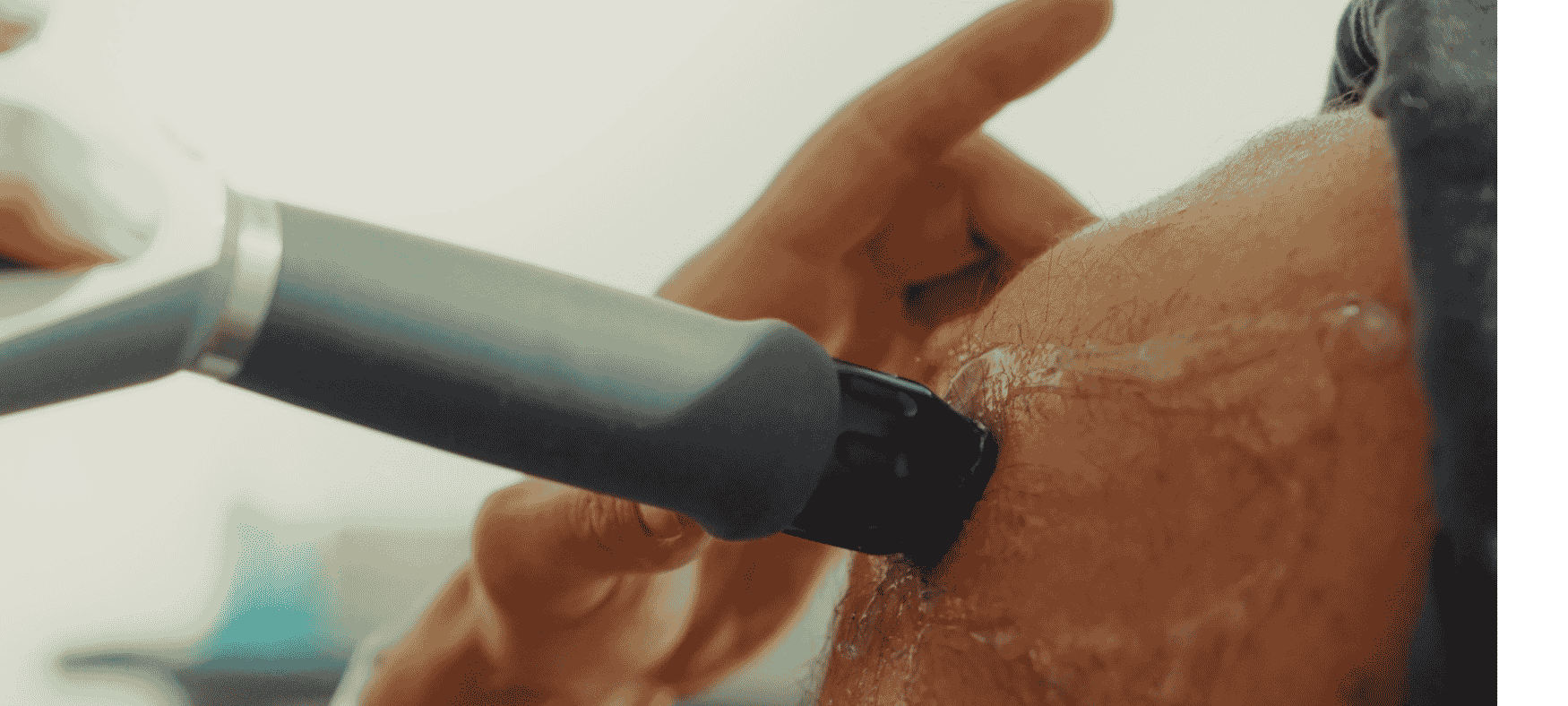
Extracorporeal Shockwave Therapy (ESWT) is a non-invasive treatment that delivers high-energy acoustic pressure waves to targeted tissue using a handheld probe. In calcific tendinitis, shockwave energy is directed at the calcium deposit with two goals: to mechanically fragment the deposit and to stimulate the body’s own healing and resorptive processes.
Radial shockwave (the most commonly used in physiotherapy clinics) delivers diffuse energy across a broader area, while focused shockwave targets a more precise point. Both have evidence for calcific tendinitis, though ultrasound-guided delivery improves accuracy and outcomes.
What Does the Evidence Say?
The evidence for shockwave therapy in calcific tendinitis is among the strongest in musculoskeletal physiotherapy. A 2024 systematic review and meta-analysis published in Physiotherapy Research International confirmed that ESWT is effective in reducing pain and disability and improving function in rotator cuff calcific tendinopathy, with high-energy ESWT showing particular efficacy.
A 2025 interventional clinical trial published in Diagnostics compared ultrasound-guided versus landmark-based ESWT and found that ultrasound-guided delivery produced dramatically better outcomes, with median Constant-Murley scores improving from 50 at baseline to 97 at 6 months in the guided group, compared to 79 in the landmark group.
A one-year follow-up study published in the International Journal of Surgery (2024) found that all patients showed notable improvement in pain, function, and shoulder scores after ESWT, with successful calcific resorption confirmed on ultrasound.
What to Expect During Treatment
At South Island Physiotherapy, shockwave therapy for calcific tendinitis typically involves:
- A diagnostic ultrasound assessment to confirm the diagnosis and locate the deposit precisely
- 3-6 sessions of shockwave, spaced approximately 1 week apart
- Each treatment site takes about 5-10 minutes, with the full session performed in clinic
- A concurrent rehabilitation program to address any weakness, compensatory movement patterns, or shoulder dysfunction
Most patients experience some discomfort during the procedure, as the acoustic energy is intense, but this is typically well-tolerated and brief. Some temporary increase in soreness over the following 24-48 hours is normal and indicates the tissue is responding.
Every clinician who uses shockwave therapy at our clinic holds active registration with the College of Physical Therapists of BC and has completed additional training specific to the technique, in keeping with our evidence-based approach to care.
Is Shockwave Right for You?
Shockwave therapy is most appropriate for patients who have:
- Confirmed calcific tendinitis on imaging
- Symptoms lasting more than 3-6 months
- Not responded adequately to physiotherapy exercises, anti-inflammatories, or cortisone injections
It may not be appropriate for those on blood thinners, during pregnancy, over areas with active infection, or in certain other medical circumstances. Your physiotherapist will conduct a full screening before proceeding.
Frequently Asked Questions
- How Many Shockwave Therapy Sessions Will I Need for Calcific Tendinitis?
Most patients need 3 to 6 sessions of shockwave therapy, spaced about a week apart. Your physiotherapist will confirm the right number based on your ultrasound findings and how you respond to treatment.
- Is Shockwave Therapy Painful?
Most patients feel some discomfort during treatment since the acoustic energy is intense, but it’s brief and well-tolerated. Some soreness for 24 to 48 hours afterward is normal and means the tissue is responding.
- Do I Need a Doctor’s Referral for Shockwave Therapy in Victoria BC?
No referral is required to book a physiotherapy assessment at our Saanich clinic. We can assess your shoulder, confirm the diagnosis with ultrasound, and build a personalized treatment plan from there.
Ready to get back to your best self?
If calcific tendinitis is holding your shoulder back, the team at South Island Physiotherapy in Saanich is here to help with a personalized treatment plan built for your recovery. Call us at (778) 433-4900 or book your shockwave therapy assessment online, and we will take it from there. We proudly serve patients across Greater Victoria, including Oak Bay, Langford, and Esquimalt, and we offer direct billing to ICBC and WorkSafeBC, plus most extended health plans. See what our Saanich clinic patients are saying on Google.